Wednesday, 1 April 2020

The Weft

This must be the time to have a look at the yarns.
First the warp. This is the cone after winding the first warp. It's good to know there is plenty on there for the second warp . . . the one for the centre panel.

The same as for the warp, there are two threads together in the weft. The darker one is labelled 60% alpaca with some other fibres in there I can't identify because of the language. The light one I thought was mohair but who knows? I won't know what is in these yarns till I find someone who can read Chinese.
It may seem strange using such contrasting colours together but neither on their own are quite right and this is what my sampling told me. . . see, it is useful to sample. Using three different shades together delivers a brighter and more interesting colour than one bland colour throughout so I am pleased with the result.


It does mean a little more prep, winding the two threads together, but that can be done during TV time or in a coffee break. This is how I stopped the balls rolling around the furniture.


Now that one large ball has been woven up (approx 1.3metres) I can do the maths and work out that I have plenty of yarn to complete the project. I was fairly confident, but it is nice to have mathematical proof.

Tuesday, 31 March 2020

Weaving

I have some lovely ski shuttles but they never seem to work for me. I thought this might be the time for them . . . but no, not for this job. They catch on the warp too much . . . probably because of the way I hold them. I think my arms are not long enough.


Tried and true . . . out comes the stick shuttle. 

The first half metre is done!

Monday, 30 March 2020

Tying Up

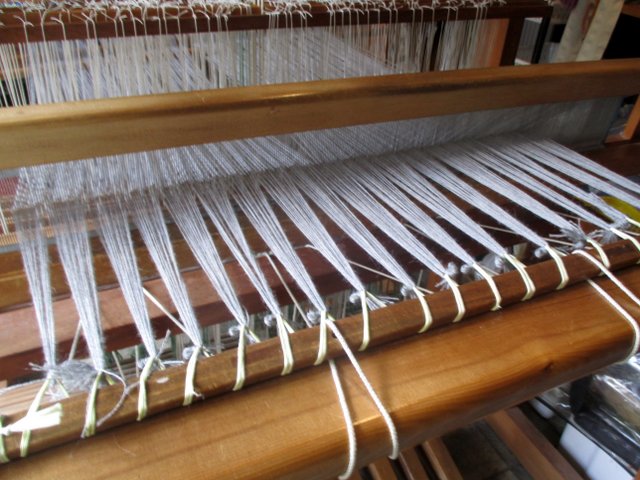
Finally . . . sleyed the reed correctly

and lashed the warp on to the front stick. . . my preferred way to tie the warp on with minimum waste

Last task is to re-tie the pedals according to the pattern I have chosen. Yes, I can still get in there but I fear the day may be coming when I can no longer get out!

Sunday, 29 March 2020

Sleying

Precision required for this job, though this time it needs just one double thread through each dent in the reed - easy (or is it?)

My trusty hook is the best tool for this job. If I drop it I can't find it easily because it is the same colour as the vinyl on the floor..

I had to back-track a few times because I did make a couple of mistakes. Hopefully I have it right now so will soon be throwing the shuttle.

Friday, 27 March 2020

Threading the Heddles

The cross, decently and in order

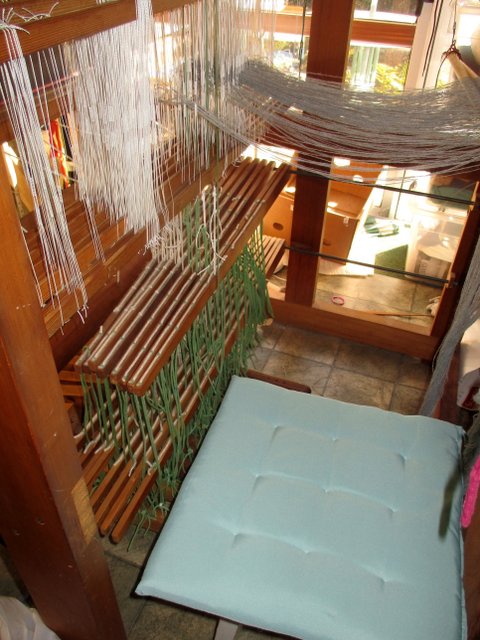
This is where I sit. There is just enough room.

I use my fingers to thread the heddle eyes. With a bit of practice it is much quicker and less cumbersome than using a hook.

I can't take a photo with both hands in the shot but I'm sure you get the picture

As always, keeping a bit of tension on keeps everything in order.

All done.
If any new weavers are following this you may be surprised that I thread the heddles first and then sley the reed separately as you may have been taught to use a long hook and do it in one operation. My loom is longer from front to back than most, with more space both in front of and behind the heddles. I work on my own and I just can't reach to thread the heddle and reed in one operation. I also find it less confusing to do one task at a time.

Thursday, 26 March 2020

Beaming the warp

End of the warp spread across the raddle on the back beam.

And the rest spread across the floor

These handy fishing weights are like a spare pair of hands for me at this stage.

They hold the warp under tension while I wind it on
Rolling on with protection between layers. I love big posters, especially laminated ones.
Bit by bit the choke ties are discarded and the warp is wound on. Finally it reaches the cross at the other end of the warp.

Wednesday, 25 March 2020

The Warp

Four warps ready to beam. I don't chain them when I am going to use them straight away. Note the choke ties; they are fabric strips sold for use in the garden, easy to tie and untie.

I wish you could feel this lovely stuff. Note the shoe lace tie - perfect for the job. In the 1970s in Auckland we could buy a big bag of shoelaces from the factory for 50c. I still have a lot of them.